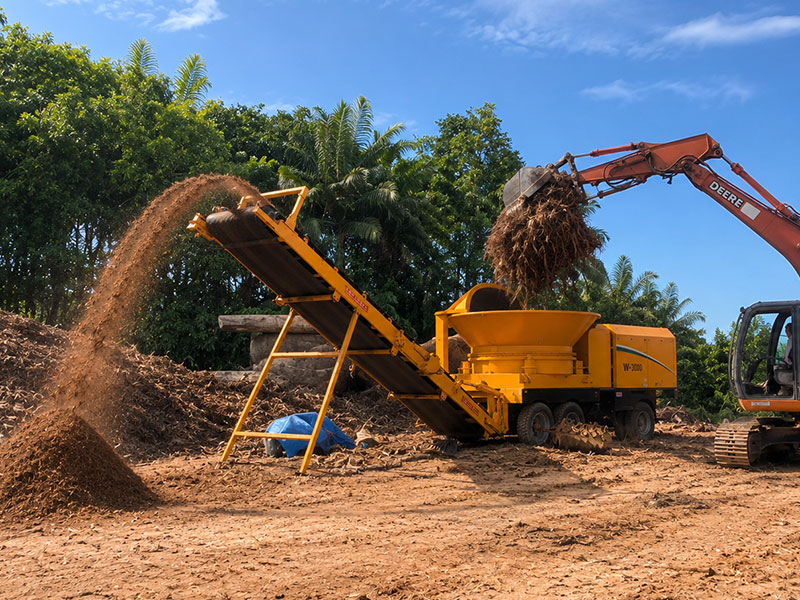
Orchard prunings feed characteristics can explain why two proposals for a tub grinder look very different. The phrase “fruit-tree branches” leaves out fork geometry, storage history, leaves, soil pickup and the way the loader presents a bundle. Engineers need a material description that another person can reproduce, not a single attractive photograph. This guide shows how to prepare that description before comparing configurations or arranging a demonstration.
Assign an identity to every sample lot
Start with the orchard block or source, collection date, tree species where known and pruning operation. Distinguish regular seasonal pruning from major limb removal. Record whether a load was collected directly, raked into a windrow or scraped from the ground. Keep the material identity attached to photographs, measurements and any output samples produced later. A test result loses much of its value if nobody can say which material it represents.
Avoid mixing a difficult load into an easier one before documenting both. Mixing may be part of the eventual operating method, but it should be described as a deliberate preparation step. Otherwise the supplier may propose equipment for an average feed that never arrives consistently. Retain the range of conditions expected across the contract, not just the central estimate.
Measure geometry beyond maximum diameter
Record representative branch lengths, thick sections and the shape of forks. Explain whether pieces are straight, curved, branched or tangled together. These observations do not replace the manufacturer’s permitted feed dimensions. They help the supplier understand how material is likely to be presented and whether preparation is required before it enters the approved process.
Photograph several representative bundles from safe positions with a visible scale reference. Note how the bundles were made and whether they spring apart or hold together during normal handling. Do not enter a hazardous pile or approach operating equipment to obtain a measurement. Use a safe, isolated sample area and the site’s material-handling procedure for detailed inspection.
Describe moisture with a method and a basis
Freshly collected branches and stored prunings may differ in moisture, but appearance alone cannot quantify that difference. If moisture is measured, record the sampling method, instrument or laboratory method, date and whether the result is reported on a wet or dry basis. Do not compare numbers with different bases as if they were directly interchangeable. Label unmeasured impressions as observations, such as recent rain exposure, rather than assigning a percentage.
Keep storage history beside the measurement. State whether the pile was covered, exposed, moved or mixed with another lot. A result from one small piece should not silently become the moisture value for a heterogeneous stockpile. The feed size, moisture and screen discussion explains why test conditions need to stay visible; orchard material still requires independent sampling.
Separate bulk density from material identity
Loose branches contain substantial void space, and loading changes how a volume is occupied. If the project uses a volume estimate, describe the container or pile-measurement method and whether the material was settled, compressed or loosely placed. A vehicle count is not a mass measurement. Where possible, retain a measured net load weight with the associated volume observation.
Do not borrow a chip-density figure to convert an unprocessed branch pile into tonnes. Even a measured density needs a stated material condition and sampling boundary. This distinction matters when suppliers discuss feed rate, transport or storage. Keep mass, loose input volume and finished output volume in separate columns so later calculations cannot accidentally mix them.
Record non-wood components before choosing the machine
Note leaves, grass or other vegetation separately from stones, soil, wire, plastic and irrigation components. Describe how these enter the collection stream and which inspection or separation step removes them. Unknown objects and material outside the manufacturer’s limits should not enter a trial. A grinder selection exercise is not a substitute for an effective receiving boundary.
Ask the orchard manager about any separate plant-health restrictions on moving or reusing the prunings. Size reduction does not prove that material is suitable for returning to the orchard. Keep that decision under the appropriate agricultural guidance. The engineering material sheet should record the approved destination rather than inventing a disease-control benefit for grinding.
Use a compact feed passport
| Field | What to record | Common ambiguity to avoid |
|---|---|---|
| Source and lot | Block, pruning operation, date and collection method | “Mixed branches” with no traceable origin |
| Geometry | Representative dimensions, forks and bundle photographs | One maximum diameter presented as a complete description |
| Condition | Leaves, storage history and documented moisture method | An estimated percentage without a measurement basis |
| Quantity | Net mass or clearly defined loose volume | Truck count automatically converted to tonnes |
| Release status | Contamination inspection, preparation and approved outlet | Assuming all orchard material is clean and acceptable |
Turn the passport into supplier questions
For each proposed tub grinder configuration, ask what preparation is required, which material conditions were assumed and how a representative demonstration would be organized. Keep these answers with the quotation. The orchard biomass selection guide connects the feed passport to the receiving customer’s output requirements.
If a different feed arrangement is being compared, use the horizontal wood grinder overview as context, while sending the same material evidence to each supplier. Submit the passport through the engineering enquiry page. A clear description makes exclusions and test limits visible before purchase, and creates a useful baseline when the real feed changes during operation.