Author: Micheal (Senior Sales Manager at WD Machinary)
Calculating the return on investment (ROI) for an industrial wood grinder involves balancing your initial capital expenditure against long-term operational savings and increased biomass production throughput. To determine your true ROI, you must precisely calculate your daily processing volume, factor in fuel or electrical consumption costs, and subtract predictable wear-part maintenance like hammer tip replacements. Investing in a high-efficiency machine like our WD1690 or WD3600 series maximizes ROI by drastically reducing cost-per-ton production costs and minimizing unscheduled downtime. Ultimately, a properly calculated ROI proves that a premium, reliable grinder transforms raw forestry waste into a highly profitable, consistent energy revenue stream.
Introduction
As a biomass plant owner or project manager, you know that efficiency is the thin line between a highly profitable operation and a breaking-even venture. When discussing procurement with international buyers at WD Machines, the conversation quickly moves from the mechanical horse-power to financial horse-power. Buyers don’t just ask me about rotor speeds; they ask: “Micheal, how quickly will this machine pay for itself?”
Purchasing a heavy-duty industrial grinder—whether it is a massive crawler tub grinder or an enclosed horizontal processor—is a major capital commitment. To justify this investment to your board or financial backers, you need a bulletproof ROI calculation. This guide breaks down the exact formulas, hidden costs, and revenue drivers you must track to determine the true financial return of your wood grinding equipment.
1. The Core ROI Formula for Biomass Operations
At its simplest, Return on Investment is calculated by taking the net profit generated by the equipment, dividing it by the total cost of the investment, and multiplying by 100 to get a percentage.
ROI (%)=(Total Cost of InvestmentFinancial Gains Breakdown−Total Cost of Investment)×100
However, for a biomass plant, the “Financial Gains” aren’t just raw sales numbers; they are built from increased tonnage output, reduced waste disposal fees, and improved fuel consistency which increases boiler efficiency.
[IMAGE DESCRIPTION: A financial flowchart infographic displaying the inputs of Grinder Procurement Costs vs. the outputs of Daily Tonnage Revenue, Fuel Savings, and Reduced Processing Time leading to a rising ROI arrow.]
2. Breaking Down the Variables
To populate your financial model, you need to analyze four critical operational areas: Capital Expenditure (CapEx), Operational Expenditure (OpEx), Wear Cost, and Revenue Generation.
A. Total Capital Expenditure (CapEx)
This is your baseline investment. It must include:
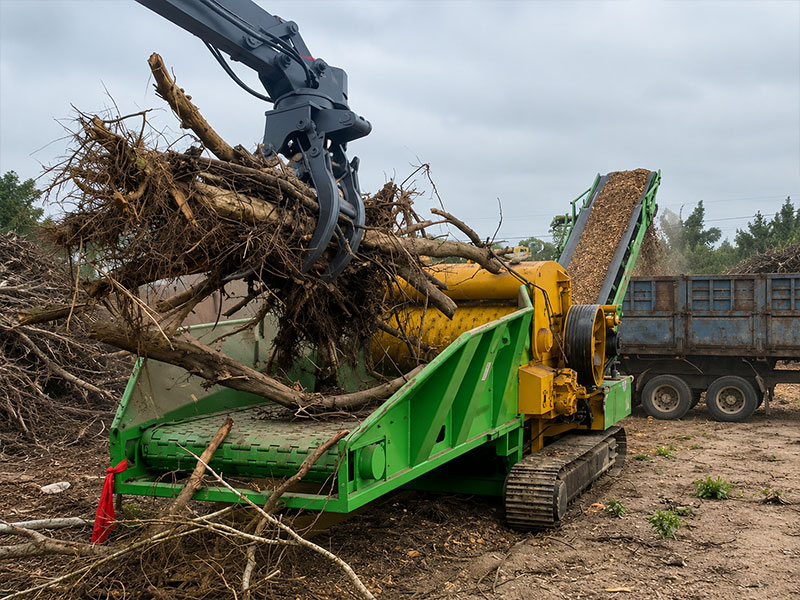
- The purchase price of the grinder (e.g., a tracking WD1690 Horizontal Grinder or a WD3600T Trailer Tub Grinder).
- Import duties, ocean freight logistics, and local port clearance fees.
- Site preparation costs (concrete pads, localized safety barrier installations).
B. Operational Expenditure (OpEx)
Your daily running costs dictate your long-term margins.
- Fuel/Power Consumption: Industrial diesel engines consume a measurable amount of fuel per hour. For electric-driven static units, track your kilowatt-hour (kWh) industrial electricity rates.
- Labor Costs: Calculate the hourly wages of your loader operators and ground safety crew dedicated to feeding the machine.
C. Wear Parts and Maintenance (The Hidden Factor)
Grinding wood, bark, stumps, or agricultural residues causes extreme abrasive wear. You must budget for:
- Hammer Tips: Tungsten carbide tips must be rotated or replaced based on material abrasiveness.
- Screens and Rods: Sizing screens eventually warp or thin out and require replacement to maintain precise calibrated chip output sizes.
3. Industrial Grinder Economic Matrix
To help your accounting team structure their feasibility report, here is an operational cost-and-revenue matrix comparing standard industry expectations based on data from our operational lines at WD Machines:
| Cost / Revenue Driver | Low-Efficiency / Used Grinder | WD Machines High-Efficiency Series |
|---|---|---|
| Average Hourly Output | 15 – 25 Tons / Hour | 40 – 70+ Tons / Hour (Material Dependent) |
| Fuel Efficiency Ratio | 0.8 – 1.0 Gallon per Ton | 0.5 – 0.6 Gallon per Ton (Optimized Feed Control) |
| Unscheduled Downtime | 15% – 20% annually | Less than 5% due to intelligent automated reverse systems |
| Calibrated Output Quality | High variance (Requires secondary screening) | High uniformity (Direct boiler/pellet feed ready) |
| Wear Part Lifespan | Standard alloy (Frequent changes) | Extended Tungsten-Carbide Facings |
4. Step-by-Step ROI Calculation Example
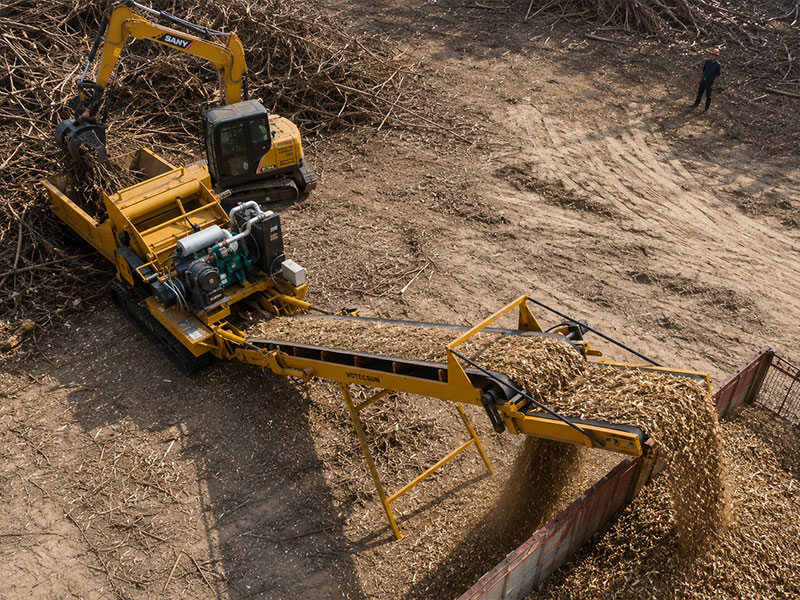
Let’s look at a realistic scenario for a biomass power plant operating a WD1690 Horizontal Grinder processing forest residuals into clean fuel chips.
Step 1: Establish Production Revenue
- Operating Hours: 8 hours per day, 250 days per year = 2,000 hours/year.
- Average Throughput: 50 tons per hour.
- Total Annual Tonnage: $2,000 \times 50 = 100,000 \text{ tons/year}$.
- Biomass Chip Market Value: $40 per ton delivered to boiler system.
- Gross Annual Gross Product Value: $100,000 \times $40 = $4,000,000$.
Step 2: Subtract Annual Operating Costs
- Diesel Fuel Consumption: 25 gallons/hour × $3.50/gallon × 2,000 hours = $175,000.
- Labor (2 Operators): $50/hour total loaded labor cost × 2,000 hours = $100,000.
- Wear Parts Maintenance Allowance: Calculated at roughly $1.50 per processed ton × 100,000 tons = $150,000.
- Total Annual OpEx: $175,000+$100,000+$150,000=$425,000.
Step 3: Calculate Net Annual Operating Profit
- Net Profit: $4,000,000 (Gross Revenue)−$425,000 (OpEx)=$3,575,000 before initial machine amortization.
If your total upfront procurement, delivery, and installation cost for the machinery was $600,000, the machine pays for itself well within its first year of continuous commercial operations, showcasing a massive multi-year positive ROI.
[IMAGE DESCRIPTION: A close-up screenshot of a digital dashboard on a WD Series grinder displaying real-time engine load optimization metrics, demonstrating how fuel consumption drops when the automated feed system regulates processing speed.]
5. How Intelligent Machinery Engineering Boosts Your ROI
When calculating ROI, many buyers look strictly at the initial invoice price. This is a critical mistake. A cheaper machine often destroys your profit margins through two factors: fuel inefficiency and excessive downtime.
Fuel-to-Tonnage Optimization
Our WD1690 uses advanced programmable logic controllers (PLC) that synchronize the feed conveyor speed with engine RPM. If the mill hits a dense, heavy oak log, the feed roller momentarily pauses or reverses, keeping the engine running at its peak torque curve without dragging down fuel efficiency. This saves thousands of dollars in fuel annually compared to old, non-regulated feed systems.
Consistency Minimizes Processing Steps
If your biomass plant produces specialized wood pellets or feeds high-efficiency industrial boilers, chip size consistency is critical. Cheap grinders produce irregular fractions, requiring you to install secondary screening decks and regrind stations. WD Machines grinders offer highly rigid screen clamping mechanisms and optimized hammer arrangements that deliver a market-ready product in a single pass, completely eliminating secondary processing machinery costs from your financial books.
6. Micheal’s Checklist for Evaluating Your Grinder Investment
Before finalizing your machinery budget, run through this final checklist to protect your ROI calculation:
- Feedstock Assessment: Is your raw wood clear logs, or is it contaminated with soil, rocks, and root spikes? High contamination requires heavier investment in magnetic separation pulleys to protect down-stream assets.
- Parts Logistics Availability: How quickly can you get replacement wear tips? A machine sitting idle for three weeks waiting for custom tracking parts represents thousands of dollars in lost processing revenue.
- Local Emission/Safety Compliance: Does your local government require enclosed grinding chambers to reduce dust emission and flying debris? If so, investing in a horizontal grinder like the WD1690 avoids expensive post-purchase environmental fines.
Conclusion: Let’s Run the Numbers Together
Calculating the ROI of an industrial wood grinder isn’t just about spreadsheets; it’s about realizing the full economic potential of your biomass raw materials. Whether you are running a land-clearing campaign or feeding a dedicated multi-megawatt energy facility, we are here to ensure your machinery investments translate into measurable bottom-line profits.
Do you need a customized financial feasibility breakdown for your processing site?
Visit our official global engineering hub at www.wdmachinary.com or reach out to me, Micheal, directly today. Send me your average daily material volume and local fuel costs, and I will personally help you calculate a highly accurate ROI model tailored specifically to your plant’s goals. Let’s build an efficient, profitable biomass production line together!