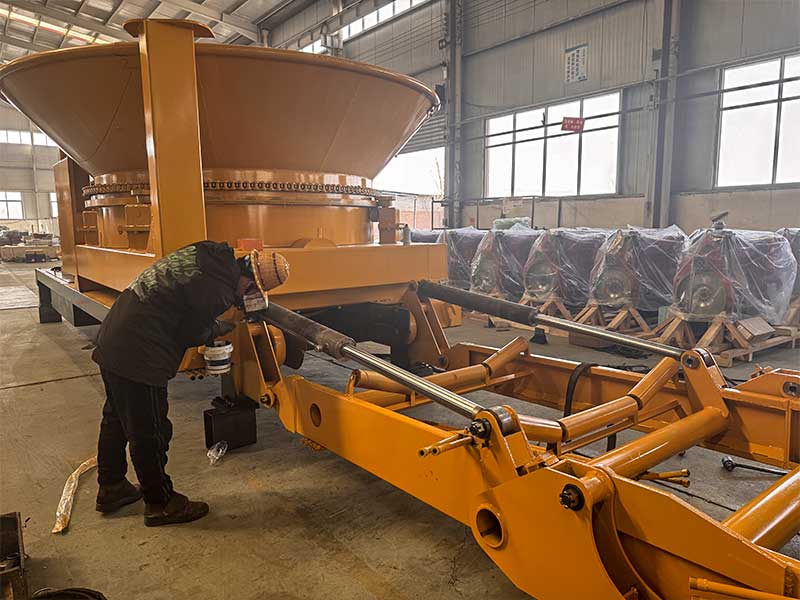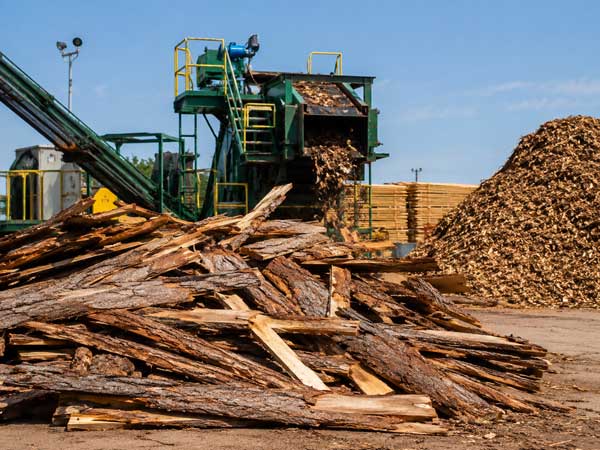
A C&D wood tub grinder throughput test is useful only when feed size, moisture and screen choice are changed as controlled variables while the material acceptance rule, loader, timing and output sampling remain fixed. Otherwise, a faster or slower result cannot be traced to one engineering cause.
Start with one released feed class
Create a written lot for approved clean offcuts, pallets, crates or another defined wood fraction. Keep unknown treated wood, loose metal, masonry, concrete, wire, soil-rich sweepings and mixed debris outside the test. Record source, storage, preparation, visible fasteners and release authority.
The earlier C&D wood feed-characteristics matrix provides the classification fields. Today’s test uses those fields to isolate throughput variables rather than to choose the initial machine type.
Measure feed geometry as a distribution
Count and measure a representative sample. Report median or typical length, width and thickness plus an upper-bound group, long flexible members, compact assemblies and fines. One maximum dimension cannot show how frequently difficult pieces reach the loader.
Create at least two geometry classes without changing material acceptance: for example, as-received approved pieces and an approved prepared class. Record preparation labor and time separately. A higher grinder rate after cutting may still produce a lower whole-site rate if preparation dominates the shift.
Define a repeatable moisture method
Use the same sampling device and procedure for every run, and record where samples were taken. Surface wetness after rain is not equivalent to internal moisture. If no calibrated method is available, use descriptive classes and disclose the limitation instead of inventing percentages.
Moisture can change bulk density, handling, fines behavior, screen loading and storage. It should be recorded beside mass, geometry and source rather than treated as a single correction factor.
Control the screen comparison
Record screen identity, opening, condition, installation check and target output. Change the screen only between completed runs under the exact machine procedure. Record the resulting oversize, fines, accepted fraction, recirculation and cleaning observations. Do not infer final particle distribution from opening size alone.
Use the tub grinder engineering section to discuss compatible configurations, but rely on the selected machine’s documentation for approved setup and procedure.
Use a controlled test matrix
| Run | Feed size class | Moisture class | Screen | Variable changed |
|---|---|---|---|---|
| Baseline | Recorded | Recorded | Recorded | None |
| A | Prepared class | Same lot | Same | Feed geometry |
| B | Baseline class | New documented condition | Same | Moisture condition |
| C | Baseline class | Same lot | Alternative approved screen | Screen |
Not every project can create every cell. Mark missing comparisons and uncertainty. Never combine different sources, operators, loader attachments and screens into one result called “the moisture effect.”
Measure time and acceptable output
Record released input mass, total elapsed minutes, productive grinding minutes, loader gaps, preparation, stops, inspections, cleaning, discharge delays, first-pass output, oversize and rejected material. Use the same scale and sampling rule for all runs.
Gross accepted-output rate = first-pass accepted mass / total elapsed hours
Productive accepted-output rate = first-pass accepted mass / productive grinding hours
The difference exposes work-cell loss. A screen may raise productive rate but create unacceptable oversize; a prepared feed class may stabilize grinding but consume extra upstream time. Engineering should report both effects.
Apply stop and inspection rules
Stop for suspected loose metal or stone, smoke, abnormal heat, unusual noise or vibration, damaged guarding, blocked discharge or lost communication. Inspection and clearing require the exact isolation procedure and authorized personnel. Link every event to the lot and sequence; do not diagnose it from memory after the shift.
Review the contamination-control workflow for its stop, quarantine and traceability structure, then adapt the incoming criteria to C&D wood.
Issue a comparison report
- Material boundary and lot identity.
- Geometry distribution and preparation time.
- Moisture method and limitation.
- Screen identity, condition and output target.
- Gross and productive accepted-output rates.
- Oversize, fines, stops and abnormal events.
- Uncertainty and the next test needed.
Send the matrix and representative photographs through the engineering contact page. For purchasing use, compare the results with the site throughput planning method. The goal is a traceable response surface, not a universal capacity promise.
Check repeatability before interpreting a difference
Repeat the baseline at the beginning and end of the trial sequence. If the two baseline results differ materially, investigate wear, operator rhythm, lot variation, moisture change, screen loading, discharge conditions and measurement error before attributing the change to the planned variable. A comparison without a stable baseline can produce a persuasive but incorrect conclusion.
Report individual runs, average and range. State the scale resolution, sample method and timing threshold. Do not remove a slow but valid run merely because it lowers the result. Exclude a run only under a written rule, preserve its record and explain the reason.
Turn the matrix into operating limits
Use the test to define observed conditions that require reclassification or another trial: a new source, more long pieces, a different moisture class, higher contamination exposure, a screen or wear-state change, a new loader, or a new output destination. These are triggers for review, not claims that the machine will fail. The controlled record tells engineering when prior evidence no longer applies.
Archive the evidence package
Store the raw scale readings, timing sheet, photographs, output samples, screen record and event log together. Give the report a revision number and preserve superseded versions. When a later source or configuration changes, the team can identify which evidence still applies and which comparison must be repeated.
Record the reviewer, date and unresolved question so the next trial begins from a controlled baseline rather than an undocumented recollection.