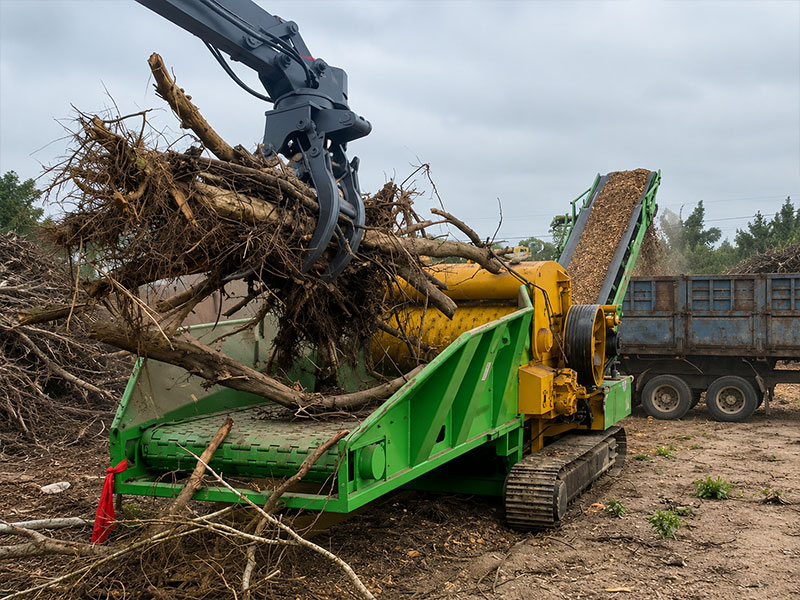
C&D wood feed characteristics for tub grinder selection affect tub grinder selection through five engineering variables: contamination exposure, piece geometry, density and moisture variability, presentation method and required output. Treating all construction wood as one homogeneous stream can hide the actual causes of bridging, impact events, screen loading and inconsistent discharge.
Build a feed-characteristics matrix
Create separate rows for clean offcuts, pallets, crates, dimensional lumber, dismantled assemblies and any other approved fraction. Do not mix unknown treated wood, masonry, soil-rich sweepings, cable, loose metal or general demolition debris into the test lot. The receiving rule and destination requirement determine what may enter the process.
| Characteristic | Field observation | Selection implication |
|---|---|---|
| Long flexible members | Board length, forks, bundles | Feed presentation and bridging controls |
| Dense or compact pieces | Thickness, stacked assemblies | Impact loading and preparation decision |
| Fasteners and mixed debris | Visible and suspected contamination | Sorting, quarantine and wear exposure |
| Fines and moisture | Dust, wet fines, storage condition | Screen loading and discharge management |
| Loader behavior | Grab size, placement, cycle variation | Work-cell rate and control stability |
Measure a distribution, not one maximum
Record typical and upper-bound length, width and thickness from representative released loads. Note the percentage of long members, compact blocks, tangled pieces and fines. A single maximum dimension cannot describe how often the loader encounters difficult material or whether preparation becomes the rate-limiting step.
Photographs need a scale and lot identity. Keep the source, storage surface, weather exposure and sorting method with the measurement. Compare this method with the existing feed-characteristics framework for irregular woody material, while preserving the different contamination rules for C&D wood.
Separate contamination risk from normal wear
Visible nails in an otherwise approved wood fraction are not equivalent to loose structural metal, wire, concrete or unknown debris. Define the acceptance boundary before the trial and record every event against the lot and feed sequence. Do not clear jams or inspect damaged areas until the exact machine isolation procedure has been applied by authorized personnel.
Review the contamination-control workflow for its stop, quarantine and traceability structure. Adapt the receiving criteria to C&D wood rather than copying forestry assumptions.
Connect feed presentation to machine response
Log how the loader places long boards, dense grabs and mixed geometry into the tub. Record productive time, total elapsed time, feed interruptions, recirculation, abnormal sound or vibration, temperature observations and output acceptance. Change only one controlled variable at a time.
Use the tub grinder engineering section to discuss configuration boundaries, then validate them with representative material. If the loader cannot meter the lot consistently, the result may describe loader behavior rather than grinder capability.
Define the screen and output evidence
State the target outlet and sampling method before selecting a screen. Record oversize, fines, visible contamination and any downstream separation requirement. Do not claim that a screen opening alone guarantees the final product; feed geometry, wear condition, recirculation and sampling all influence the observed distribution.
The feed-size, moisture and screen test structure shows how to keep those variables visible. Use a separate C&D wood lot and acceptance rule.
Issue an engineering selection record
- Approved feed fractions and prohibited items.
- Geometry distribution and representative photos.
- Contamination class and release authority.
- Loader, presentation method and work-cell layout.
- Screen, sampling method and accepted output.
- Observed stops, wear events and maintenance response.
- Uncertainty, owner and next validation date.
Send the matrix, photographs and trial plan through the engineering contact page. For a purchasing-stage comparison, pair it with the construction-waste material boundary guide. Selection should follow evidence from the intended stream, not a generic material label.
Create event-triggered inspection rules
A calendar interval alone cannot represent sudden changes in C&D wood. Add event triggers for a new source, visibly higher fastener content, suspected loose metal or stone, a screen change, abnormal sound or vibration, heat, smoke, repeated bridging, damaged guarding and a sharp change in output. State who stops the process, who may inspect and which evidence is required before restart.
Keep event observations factual: lot, time, feed sequence, symptom, stopped condition, authorized inspection result and disposition. Avoid diagnosing the cause before the machine is secured and the evidence is reviewed. This distinction prevents a material-control failure from being recorded as routine wear.
Use a controlled trial sequence
- Release one representative lot under the written acceptance rule.
- Record baseline geometry, contamination class, screen and loader.
- Run a defined observation period without changing multiple variables.
- Sample output using the agreed method.
- Review stops, rejects, machine response and wear observations.
- Change one controlled variable and document why.
Do not compare runs that used different lot definitions or output acceptance. If weather or storage changes moisture materially, start a new condition record. The objective is not to manufacture a favorable number; it is to discover which inputs control a stable and supportable process.
Translate observations into a supplier question list
For every high-variation characteristic, ask what preparation, operating observation, service response and evidence the proposed configuration requires. Request the allowed material boundary, screen options, inspection points, wear-part identification, critical spares and support escalation. Keep the answer beside the measured project condition.
This list prevents a supplier response for clean boards from being applied to mixed approved C&D wood. It also shows which questions remain open before a witnessed trial. Record the document revision and responsible reviewer so later commercial changes can be traced to the same engineering boundary. Preserve superseded answers when the source stream or outlet requirement changes.